
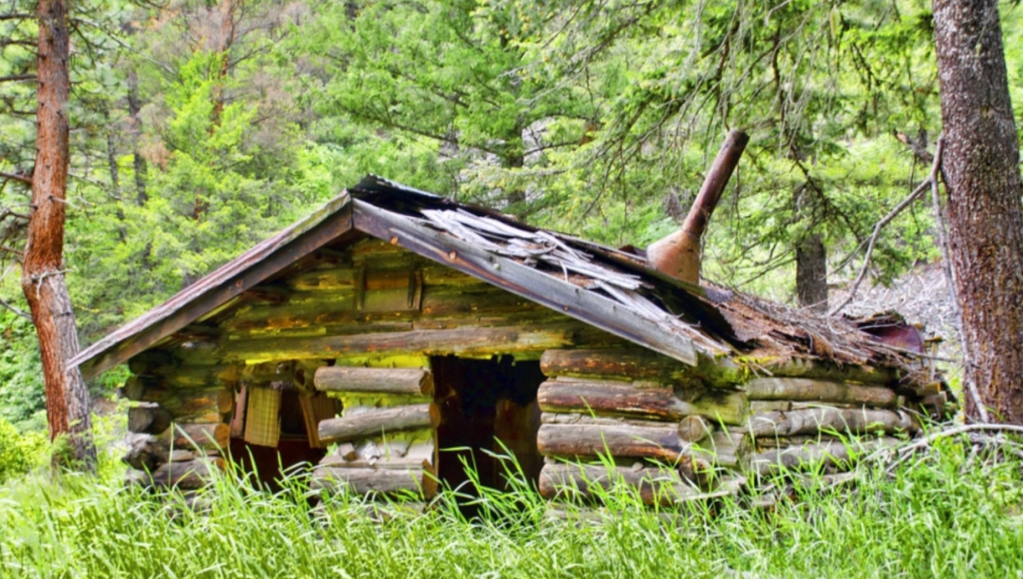
Ulysses is one of the many abandoned mining camps in Lemhi County, located in Central Idaho. The old townsite is located up Indian Creek, downriver from the town of Salmon. Explorers interested in seeing what is left of the camp can simply head up Indian Creek a few miles past the Indianola Ranger Station.
Echoes from this part of the American West were expressed in the Idaho Recorder, September 12, 1902, by an adventurous reporter who had this to say.
“Your representative was agreeably surprised at the great activity on Indian Creek where I spent a day looking over the camp. There are about a 100 men at this place, with post office, store, and two saloons.
Seven families have their homes on the creek. Through the courtesy of R.L. Edwards, the manager of the Kitty Burton Mining Co who did all in his power to make my visit a pleasant one. I gleaned the following information.
The Ulysses mill and mine has 10 men on the payroll. At the mine, a force of 15 men are employed under the supervision of Dan Kane. At present they are mostly engaged in moving the machinery of the old mill to the site of the new mill and in stripping ore.
The new mill is located on the south side of Indian Creek a quarter of a mile above the forks and 3200 feet distant from the mine. It is strictly up to date and no expense has been spared to make it one of the best equipped plants in the state. The mill will be supplied with both waterpower and steam.”
An earlier news report indicated the need for a post office and consistent mail shipments. “Ulysses, the new and thriving Idaho camp is after a daily mail service and wants it to come via Divide, Wisdom, and Gibbonsville. The distance from Wisdom to Ulysses is 61 miles, and Supt. O’Connel of the stage line advises that the trip from Divide to Ulysses can be made in two days. Three change stations would be needed between Wisdom and Ulysses at Sunrise, Gibbonsville, and North Fork.”
Though largely forgotten, the remnants of Ulysses offer a glimpse into the history of mining in Idaho, an industry that drove settlement, shaped local economies, and transformed the landscape. This brief essay delves into the history, geography, and eventual decline of Ulysses, Idaho, shedding light on the forces that led to its rise and fall.
The Founding and Early History of Ulysses
Ulysses was established around 1901, with mining at the heart of its formation. The town is located up Indian Creek, in a region known for its mineral wealth. Although mining claims in the area were filed as early as 1895, significant activity did not begin for six more years, when the Kittie Burton and Ulysses mines were developed. These mines primarily sought gold and silver, which were the key resources driving the mining booms in Idaho during this period
The mining operations in Ulysses were financed by stockholders who supported the construction of the Kittie Burton Mill. This mill played a central role in the local economy by processing the ore extracted from the surrounding mines. The construction of cable tramways that connected the mines to the mill allowed for more efficient transportation of materials, reducing the labor required to haul ore across the rugged terrain. The development of such infrastructure underscored the optimism surrounding the town’s future, as investors and miners alike hoped to strike it rich. This setup was crucial in an area as remote and mountainous as Ulysses, where transportation of heavy ore by hand or horse-drawn vehicles would have been slow and labor-intensive .
A news report from the Idaho Recorder described some bad luck and setbacks experienced by the Kittie Burton Mill workers.
“News was received over the phone from Ulysses of the complete destruction of the Kittie Burton mill by fire last night. No particulars were given. The mill was insured for $27,000 and it is estimated that it can be rebuilt for that amount. However, it will throw about 75 men out of employment for a time at least.”
Shortly after the destruction of the mill, the following report was printed in the Lemhi Herald on September 28, 1905. “James Mahaffey and family have removed to Salmon from Ulysses and taken up their abode in one of the Dick Johnson’s houses. Mr. Mahaffey has been a regular, steady, and trusted employee of the Kittie Burton for about two years past. The burning of the mill has caused his cessation of service, as it also put out a great many others. The future purposes of the company as to rebuilding have not yet been announced.”
The mill was rebuilt and work continued in mining operations near Ulysses until around 1919, when it was closed. The Recorder Herald reported on June 10, 1927: “One of the most important deals of the recent years was made this week, when Salt Lake and Idaho Falls capital took over all the holding of the Kittie Burton Gold Mines company, and the property of the W.W. Smith, on Indian Creek, under bond and lease, and work will be started down there at a very early date, with the expectation of the beginning of production before winter arrives.
Thomas Boyle will superintend the underground work for its new corporation, beginning where he left off when working for the Kittie Burton company some ten years ago.”
The Geographic and Environmental Context of Ulysses
Geographically, Ulysses was in a remote and rugged part of Idaho, characteristic of the mountainous terrain that defines much of the state. As mentioned in the introduction, the town was nestled up Indian Creek, which provided water for the settlement and the mining operations. The presence of Indian Creek was vital for Ulysses’ residents, providing not only water but also a means to process ore.
The terrain around Ulysses is mountainous and heavily forested, with pine and fir trees typical of the region. The forests would have provided the timber needed for building the town’s infrastructure, including the mine supports, homes, and the mill itself. However, the same rugged terrain that offered mineral wealth also posed significant challenges to the settlers. Isolated from major population centers, Ulysses was far from the nearest significant city, Salmon, which was about 40 miles away.
The region’s climate also presented challenges. Winters were cold and harsh, with snowfall making transportation difficult, while summers were more moderate but short. These environmental factors would have made life in Ulysses difficult, particularly as the town’s economy began to decline. As the resources that sustained the town diminished, so too did the population, leaving Ulysses to fade into obscurity like many other mining towns of the era.
The Rise and Fall of Ulysses
The story of Ulysses mirrors the rise and fall of many mining towns in the American West. Initially, the discovery of mineral resources led to a rush of settlers, including miners, investors, and those providing services such as blacksmiths, merchants, and saloon owners. Ulysses quickly developed as a hub for the local mining operations, with the Kittie Burton Mill at the center of its economy.
However, the economic foundation of Ulysses was fragile, as it relied almost entirely on the availability of gold and silver ore. Once the local resources were depleted, the town had little else to sustain its population. By the early 20th century, the mines had been largely abandoned, and without a steady influx of wealth from mining, the town’s population dwindled. The infrastructure, including the mill, fell into disrepair, and the town was eventually abandoned.
Today, Ulysses is classified as a ghost town, with only a few remnants left to mark its existence. The Kittie Burton Mill has collapsed into a pile of lumber, and the cable tramways that once connected the mines to the mill are long gone. A few original cabins remain, standing as silent witnesses to the town’s brief period of prosperity. The story of Ulysses is a reminder of the transient nature of many mining towns in the West, where fortunes were made and lost, and entire communities could disappear almost as quickly as they had sprung up.
Conclusion
The ghost town of Ulysses, Idaho, offers a fascinating glimpse into the mining history of the American West and specifically, Idaho’s Lemhi County. Like many other mining towns, it was born out of the hope of striking it rich, driven by the discovery of gold and silver in the late 19th century.
.


 HICKS FAMILY HISTORY
Leave a comment